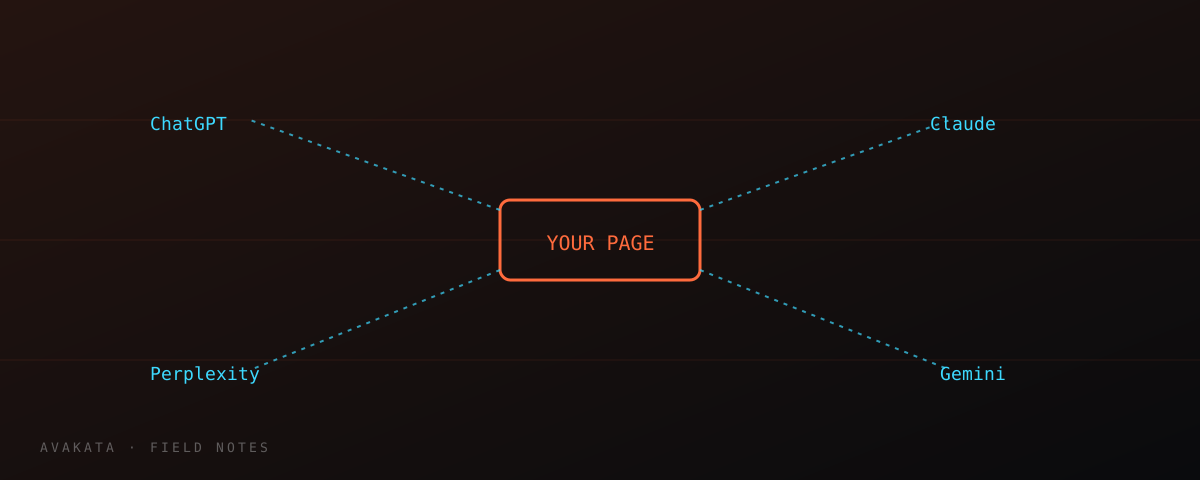
Ask an AI engine 'what is generative engine optimization' and somebody's sentence comes back, lightly paraphrased, sometimes cited. That sentence was written by a person who decided to own the definition.
Definition queries — what is X, what does X mean, X versus Y — are the highest-volume question class answer engines handle, and the easiest to win, because most industries never bothered to write clean definitions of their own vocabulary.
A 20-term glossary is the cheapest citation asset we build for clients. Here is the exact structure.
Why definition queries are the front door of AI search
Definition queries dominate AI search because every learning journey starts with vocabulary. Before anyone asks 'best agency for X,' they ask what X is. Engines answer these queries with a one-to-two sentence definition and, increasingly, a citation. Whoever wrote the cleanest, most extractable definition gets named at the exact moment a newcomer is forming their map of the field.
The commercial value is indirect but real. The source that defines the term becomes the default authority for everything downstream of it. On our own site, glossary pages earn citations at roughly three times the rate of blog posts, per word published.
Definition queries also never go stale. 'What is an idempotency key' will be asked every week for a decade.
Somebody will own that answer. It is a writing decision, not a budget decision.
What does a citable definition look like?
A citable definition is one sentence of 25 to 50 words with the term as the grammatical subject: 'An idempotency key is a unique identifier that lets a system recognize a repeated request and execute it only once.' No pronouns, no 'refers to,' no dependent setup. The sentence must survive being lifted out alone, because that is exactly what the engine does with it.
Follow the definition sentence with one paragraph of expansion, one concrete example with numbers, and one sentence on what the term is not. That boundary sentence shows up in engine answers surprisingly often, because disambiguation is half of what a definition is for.
Write the term the way people type it, including the abbreviation. Models match phrasing more literally than you would hope.
Length discipline matters. Past 50 words the sentence stops being a definition and starts being a paragraph, and engines will not lift a paragraph whole.
Pick the 20 terms you can actually own
Do not define 'marketing.' You will lose to dictionaries and universities. Own the specific vocabulary of your niche instead: terms with real search interest but no authoritative page, terms your clients ask you to explain on calls, and terms you coined or use distinctively. Twenty terms is the right first batch — big enough to read as a cluster, small enough to write well in two weeks.
Our sourcing method is unglamorous: six months of call notes and support email, mined for every phrase a client asked us to explain. That list is the glossary, pre-validated.
Check each candidate by asking three AI engines to define it. If the answers come back vague, conflicting, or uncited, the term is open. If all three cite the same strong source, pick a different fight.
Coined terms are the sleeper category. If you named the method, nobody can outrank you on its definition — but only if the page exists.
Structure the page so a machine can lift it
One term per page. The term is the H1, the definition sentence is the first paragraph, and the whole page runs 400 to 700 words: expansion, worked example, boundary sentence, and two or three related terms mentioned by name. Add a visible updated date and an FAQ entry for the question form. The page should feel almost boring. Extraction rewards boring.
Resist the urge to merge terms into one mega-glossary page. A single page defining forty terms gives the engine forty competing passages and dilutes all of them. Separate URLs won every test we ran.
Keep the definition above any table of contents or preamble. The first 60 words of rendered text are what get lifted.
The FAQ item repeats the question form — 'What is X?' — with a self-contained answer. The definition sentence and the FAQ answer should agree word-for-word on the core claim.
Make the glossary read as a cluster
Engines weigh site-level topical authority, so twenty isolated pages underperform twenty connected ones. Mention related terms inside each definition page, route glossary pages to the relevant service and blog pages, and reference glossary terms from your posts by their exact names. The goal is that any crawler landing on one definition can see the shape of the whole vocabulary.
This is also where the glossary starts paying internal dividends: every new post gets to use precise terms without re-explaining them, which tightens the writing everywhere else.
Our own 14-page buildout in July generated 61 internal connections across the site in its first week.
A glossary is a site-shaped argument that you know the field.
Keep definitions fresh without rewriting them
Definitions decay slower than tactics, but engines still favor recency. The cadence that works: re-read each definition quarterly, update the example or the statistic if the field moved, and refresh the visible updated date only when something actually changed. A 15-minute quarterly pass per page keeps a definition competitive for years. A dishonest freshness stamp, by contrast, reads as noise and erodes the exact trust the glossary exists to build.
The example is the part that ages. The definition sentence itself should be written to last — describe the concept, not this year's tools.
Log the check even when nothing changes. A dated 'reviewed, still accurate' note is a freshness signal you can surface honestly.
Retire terms honestly too. When the field abandons a term, say so on the page — 'largely superseded by X' is itself a definition move that engines reward.
Measure ownership, not traffic
Glossary pages will never top your analytics, and that is fine — the metric is citation share, not sessions. Once a month, ask the major engines each of your twenty definition questions and record who gets cited. Track your share of those twenty answers over time. Moving from zero to eight cited terms in a quarter is a real, compounding asset, whatever the traffic chart says.
Expect a lag. Our median time from publishing a definition page to first observed citation is about five weeks, with a wide spread.
Citation share also predicts the rest of the funnel. Terms we own show up in sales calls as 'I read your definition' more weeks than not.
Write the sentence you want repeated. Then let the machines repeat it.