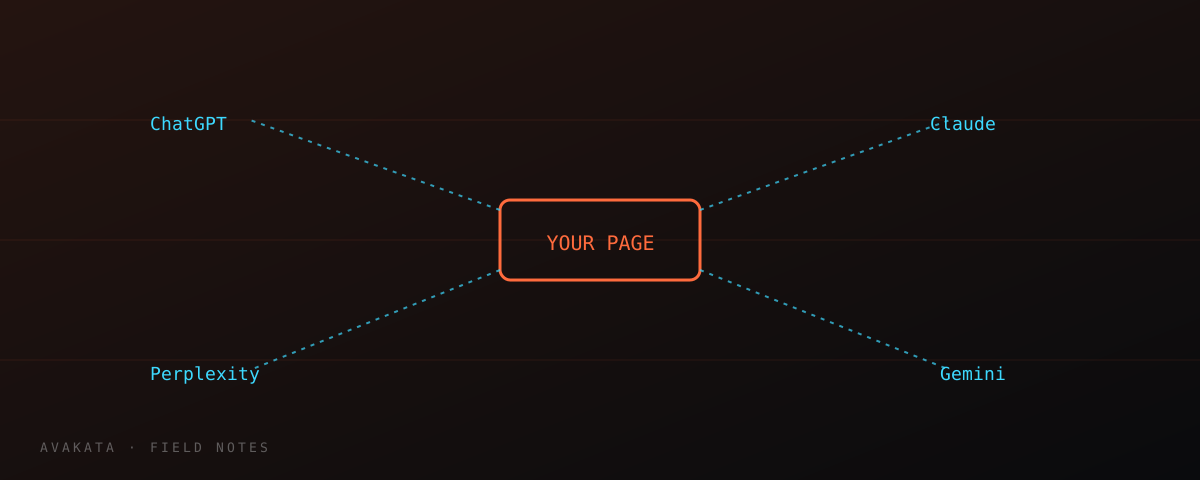
We asked the same 240 buyer questions to Google AI Overviews, Perplexity, and ChatGPT every month for six months, and logged every citation each engine returned. Just over 9,000 of them so far.
The finding that matters most: the three engines do not cite the same web. Only 12% of cited URLs appeared on all three engines for the same question. Each engine has a distinguishable taste, and a page built for one can be invisible to the other two.
Here is who cites what, straight from the logs, and what to do about it.
How we ran the comparison
The panel is 240 questions real buyers ask — pricing questions, comparisons, how-tos, and best-X-for-Y queries across our category and our clients' categories. Each question runs monthly on all three engines from clean sessions, and we log every cited URL, its position in the answer, and its page type. Six months in, that is roughly 4,300 answers and just over 9,000 citations. Small against the whole web, but large enough that the engine-level patterns repeat every single month.
One caveat before the findings: these engines update constantly.
Treat everything below as a mid-2026 reading, not a law of nature. The panel exists precisely because the answers drift.
Logging discipline is the whole method: query, engine, cited URL, position, page type. Five columns, every month, no skipped months. Anyone can replicate it.
What Google AI Overviews favors
AI Overviews behaves like Google wearing a new interface. In our logs, 78% of its citations came from pages that already ranked in the top ten organic results for the same query. It favors established domains, clean schema markup, and pages with classic SEO strength, and it cites conservatively — usually 2 to 4 sources per answer. If you do not rank, you effectively do not exist to Overviews. Your existing SEO program is your Overviews program.
The 22% that did not rank top ten is instructive: mostly pages with strong FAQ schema answering a sub-question the ranking pages ignored.
The practical read: Overviews is the engine you win slowest and keep longest.
One more Overviews note: brands cited there tell us the mention comes up in sales calls. Clicks or not, presence is the prize.
What Perplexity favors
Perplexity is the freshness engine. Fifty-six percent of its citations pointed at pages updated within the previous 90 days — the highest share of the three by a wide margin — and it cites generously, 5 to 8 sources per answer, with real room for smaller domains, community threads, and niche blogs that Overviews ignores. It rewards recently updated, tightly structured pages almost immediately. We have watched a page earn its first Perplexity citation eleven days after a rewrite.
Perplexity is where a small site sees results first. It is the closest thing to a fair fight in AI search.
It is also the least loyal. Pages that go stale fall out of its answers within a quarter, which is exactly what a freshness weighting predicts.
The maintenance implication is a standing 90-day refresh calendar for your most-cited pages. Ours runs as a recurring engine task with human sign-off.
What ChatGPT favors
ChatGPT cites least and concentrates most. Its answers in our logs carried 1 to 3 citations, skewed toward recognizable authorities — large publishers, official documentation, brands with distribution deals — and it reuses the same trusted domains across many adjacent questions. Once a domain enters its trusted set for a topic, it gets cited broadly across that topic. Getting in is slower than Perplexity and less mechanical than Overviews. Depth and consistency of coverage seem to matter more than any single page.
ChatGPT is a reputation game. You win it topic by topic, not page by page.
The volume argument for playing anyway: it still carries the largest assistant audience of the three, so one citation there can outweigh five elsewhere.
Licensing reshapes this picture year by year. Watch which publishers sign deals in your category — their added gravity shows up in the answers within weeks.
How much the three engines overlap
Overlap is smaller than almost everyone assumes. In our logs, 12% of cited URLs for a given question appeared on all three engines, and 61% appeared on exactly one. The overlap set is worth studying, because those pages share a profile: they ranked organically, they had been updated within 90 days, and they led each section with an extractable, self-contained answer. That triple-qualified profile is rare — which is exactly why the same page keeps winning everywhere when it exists.
Chasing one engine gets you one engine. Building the triple profile gets you all three.
The single-engine 61% also explains why two competitors can both claim AI visibility and both be telling the truth. Different engines, different webs.
We now report citation share per engine to clients, never a blended number. A blend hides exactly the differences that should drive the work.
One page, three checkboxes
The whole comparison collapses into a checklist you can run per page. For Overviews: does the page rank top ten for its target query, and does it carry Article and FAQ schema? For Perplexity: has it been meaningfully updated in the last 90 days, with the date visible? For ChatGPT: does your domain cover the surrounding topic deeply enough to read as an authority? Score every money page 0 to 3. Across our client set, citation counts track that score almost linearly.
Most pages score one. The work of a quarter is moving your ten most important pages to three.
The checklist also ends the wrong argument. The question is never which engine to pick. It is which checkbox each page is missing.
Scoring 40 pages takes about two hours with rank data and update dates on hand. It is the highest-leverage two hours in any GEO engagement.
Which engine deserves your effort first
Sequence by feedback speed. Start with Perplexity, because it responds to structure and freshness within weeks and tells you cheaply whether your extractable passages actually work. Carry the proven pages into your SEO program for AI Overviews, which pays slowly but compounds for years. Treat ChatGPT as the long game: publish consistent, deep coverage until the domain reads as an authority on the topic. Fast engine for signal, slow engines for durability.
That order also matches spend to evidence. You never sink a quarter into a page the fast engine already rejected.
A quarterly rebalance closes the loop: re-run the checklist, compare citation share per engine, and move the budget to the weakest checkbox. Engine taste changes. The panel catches it when it does.
Our monthly audit runs this exact 240-question panel for clients. The logs are the strategy — everything else is commentary.