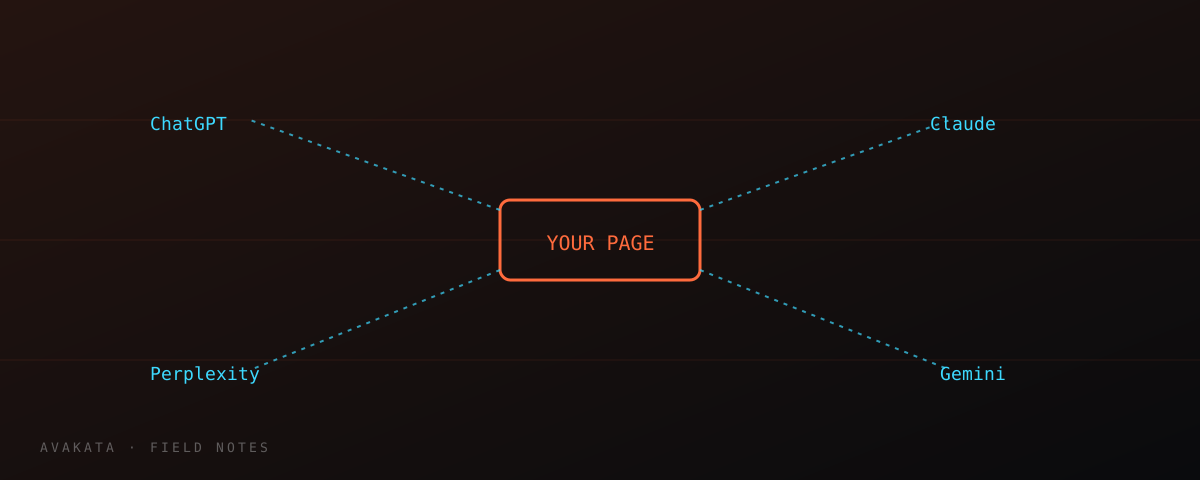
A citation in an AI answer is not a one-time win. It is a deposit that earns interest.
We have tracked every AI citation of avakata.agency and eleven client sites since October. The pattern is consistent: pages that get cited once get cited again, across engines, at an accelerating rate. Our own weekly citation count went from 3 in October to 41 in June, and the curve bends upward rather than running straight.
Almost nobody measures this, because the flywheel spins entirely outside your analytics. Here is how it works, what nine months of logs show, and how to instrument it for under an hour a month.
Why citation behaves like compound interest
Citation compounds because every mechanism that produces one citation is strengthened by that citation. An engine that cites your page delivers your framing to a reader, who repeats your phrasing in later prompts. Other engines retrieve the same passage because it now matches how the question gets asked. The domain accrues retrieval trust. Each cycle raises the probability of the next citation, and a system whose output feeds its own input is the definition of compounding.
Ranking never worked this way. Holding position eight did not make position seven more likely next month.
Citation does. The answer engines are, in a real sense, training their users to ask questions your pages already answer.
That sounds abstract until you watch a prospect open a discovery call with your own three-part framing of their problem. It happened to us twice in May. Neither prospect had ever visited the site.
The three loops inside the flywheel
We can separate three loops in our logs. The phrasing loop: engines lift your wording, users adopt it, and future queries match your page better. The trust loop: retrieval systems that cited a domain once select it more readily for adjacent questions. The demand loop: cited brands earn branded searches, and branded search volume feeds back into how heavily every engine weights the domain. Same flywheel, three different gears.
The loops run at different speeds. Phrasing is fastest — we see effects in two to three weeks.
Trust takes about a quarter. Demand takes six months and is the strongest of the three once it engages.
You do not get to skip a loop. But you can feed all three with the same page if you build it right.
What our nine-month curve actually shows
From October to June, weekly citations across the tracked set grew from 3 to 41, and the growth was anything but smooth. Months one through three produced almost nothing: 3 to 7 a week. Months four and five doubled that. Months six through nine tripled it again. And 62% of June's citations pointed at pages that had already been cited at least once before. New pages earn their first citation slowly. Cited pages earn their tenth quickly.
That 62% repeat share is the flywheel in a single number.
The distribution is lopsided too. Our top five pages take 48% of all citations, and we treat them as infrastructure now — updated on a schedule, guarded against regressions.
One more number from the ledger: median time from a page's first citation to its second was 24 days. From second to third, 11.
Why nobody measures the flywheel
The flywheel is invisible in standard analytics because its early turns produce no clicks. An AI answer that quotes you creates a mention, not a session. Google Analytics shows nothing. Search Console shows nothing. The only way to see it is to ask the engines your buyers' questions on a schedule and record who gets cited — which is manual, unglamorous, and skipped by almost everyone. So teams conclude nothing is happening during exactly the months the flywheel is starting to turn.
The dangerous month is month three. Zero visible return, quiet compounding underneath.
Most teams quit in month three.
The fix is not patience as a virtue. It is a measurement that shows the wheel turning before revenue does.
How to instrument it in under an hour a month
Minimum viable instrumentation is a fixed panel of 40 buyer questions, asked monthly to the same three engines, with every citation logged in a spreadsheet: query, engine, position, page cited. Track three numbers over time — total citations, the share of citations going to previously cited pages, and citations per engine. The panel takes about 50 minutes by hand, ten with a script, and nine monthly data points are enough to see the shape of your curve.
Keep the panel fixed. Swapping questions every month destroys the time series, and the time series is the whole point.
Add one column for competitor citations. Watching a rival's flywheel spin up in your own spreadsheet is the best budget argument you will ever have.
Total cost of ours since October: nine hours of logging and one spreadsheet. It has reshaped two client strategies so far.
Where to push to spin it faster
Push where the loops connect. Give engines a quotable sentence — a specific statistic or a crisp definition — so the phrasing loop has something to carry. Update already-cited pages every 30 to 45 days so the trust loop keeps choosing them. And put your brand name inside the extractable passage, not just the byline, so the demand loop earns branded searches. In our tests, pages with a named, quotable statistic earned their second citation 2.4 times faster than pages without one.
Do not spread effort evenly across the site. Feed the pages that are already spinning.
A new page needs everything to go right to earn citation one. A cited page only needs to stay fresh to earn citation ten.
Freshness means substance here: a revised number, a new example, an updated recommendation. Engines notice edits that change meaning, not swapped adjectives.
Early is cheap, late is expensive
Compounding systems punish late entry. A competitor who starts the flywheel six months before you does not hold a six-month lead — they hold a lead that grows while you catch up, because every citation they earn makes their next one cheaper. The strategic move is unglamorous: start the panel, ship extractable passages, and accept a quiet quarter. The quiet quarter is the price of admission, and it does not get cheaper by waiting.
We tell clients the same sentence every time: the flywheel does not care when you believe in it. It cares when you start it.
Start ugly if you must. A five-question panel logged in a notes app this week beats a perfect dashboard that ships next quarter.
If you want the panel run for you — 40 questions, three engines, a monthly diff with the moves highlighted — that is a standing part of every Avakata engagement.