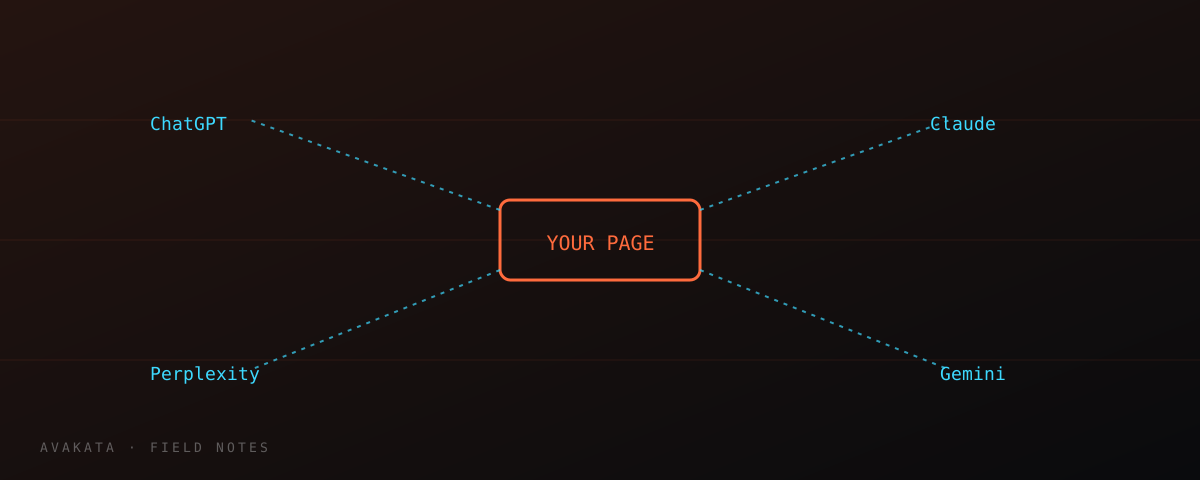
Ask ChatGPT what your brand is. Not your name — what you are. If the answer is generic, wrong, or "I don't have information about that company," you do not have a content problem. You have an entity problem: the machines composing answers about your category do not know you exist as a thing.
Keywords are strings. Entities are things — a company, a person, a product, with stable facts attached. Answer engines reason over things. Making your brand one of them is the least glamorous, highest-floor work in all of GEO.
Here is the process we run for clients, and the 60-day timeline it honestly takes.
What an entity is, and why keywords stopped being enough
An entity is a distinct thing a machine can identify, describe, and connect to other things: a company with a category, a founder, a location, a founding year. Keywords match text. Entities carry facts. When an answer engine assembles a response, it prefers claims it can attach to a resolvable entity, because attributable sources make its answer defensible. Unknown brands get paraphrased. Known ones get named.
You can rank for keywords while remaining a thing machines cannot describe. Plenty of businesses do. They get traffic and no citations, and in 2026 that is half the visibility that matters.
The distinction shows up right in the interface. Engines hyperlink entities, describe them without hedging, and volunteer facts you did not ask for. Strings get quoted. Things get recommended.
Entity work is the floor, not the ceiling. Nothing else in GEO compounds until it is done.
Run the five-engine test first
Before fixing anything, measure. Ask ChatGPT, Claude, Perplexity, Gemini, and Google AI Mode the same three questions: "What is [brand]?", "What does [brand] do?", and "Who founded [brand]?" Score each answer right, vague, or wrong. Fifteen answers, ten minutes. A brand with healthy entity signals gets at least twelve right. Most small businesses we audit start under five — not maligned, just missing.
Save the transcript with a date. It is your baseline, and re-running it monthly is how you will know the work below is landing.
Wrong answers matter more than missing ones. A model confidently misdescribing you is repeating a source you have not found yet.
Include two competitors in the test while you are at it. Their scores tell you whether the gap is your category or just you.
Write the canonical sentence once
Every entity strategy starts with one sentence you are willing to see everywhere: "[Brand] is a [category] that [does what] for [whom], based in [place], founded in [year] by [name]." Under 30 words, no adjectives a lawyer would smile at. This sentence is the fact machines will store, so every place it appears must match — word-for-word beats close-enough.
Consistency is the mechanism, not a nicety. Knowledge graphs resolve entities by matching descriptions across sources. Five slightly different bios read like five slightly different companies.
Resist the urge to be clever in it. Clever is for the tagline. The canonical sentence is infrastructure.
Ours took four drafts and one argument. Budget an hour. It is the highest-leverage hour in this entire post.
Wire the plumbing: Organization schema and sameAs
Machines need the sentence in structured form. Add Organization schema to your homepage with name, url, logo, description — the canonical sentence — founder, foundingDate, and address, then a sameAs array linking every profile that represents you: LinkedIn, Google Business Profile, Crunchbase, directories, social accounts. sameAs is the underrated field. It tells crawlers all those scattered profiles are one entity, which is precisely the resolution problem you are trying to solve.
Then make the profiles agree. Same name, same sentence, same founding year, everywhere. We keep a one-page entity sheet per client and paste from it, never from memory.
Person schema for the founder matters nearly as much for service businesses. People cite people.
Validate with a schema checker after every change. A syntax error fails silently — the page looks fine and the graph learns nothing.
Fifteen minutes of JSON, most of it copy-paste.
Build an about page machines can parse
The about page is where engines go to learn what you are, and most about pages tell a story instead of stating facts. Keep the story, but open with the facts: the canonical sentence first, then plain declarative claims — founded when, by whom, doing what, for whom, from where. Question-shaped subheads help: "What does [brand] do?" followed by a 50-word answer is an extraction gift.
Add the numbers you can defend: clients served, projects shipped, years operating. Specifics make an entity feel load-bearing to a model deciding whether to cite it.
Mark the page up with AboutPage schema and keep the founder's photo near the founder's name. Multimodal crawlers read pages, not just paragraphs.
If your about page says "passionate about excellence," a machine learns nothing except that you had a website budget.
Co-occurrence: show up next to your category
Engines learn what you are partly from the company you keep. When your brand name repeatedly appears near your category term — in directories, podcast show notes, guest posts, partner pages — the association hardens in the graph. This is why entity work extends off-site: every third-party mention that pairs your name with your category and your canonical facts is a vote for the machine's model of you.
Two mentions a month is enough cadence for a small brand. A directory listing, a podcast appearance, a partner's tools page. Boring, compounding, effective.
Mind phrasing drift. "Web design studio" in one directory and "AI agency" in another splits the vote.
We log every mention in the entity sheet, with the date and the exact phrasing used.
Wikipedia is not required. Useful if you clear the notability bar, but thousands of well-resolved entities never touch it.
The 60-day timeline, honestly
Expect the loop to take about 60 days: schema and profile cleanup in week one, the about page rewrite in week two, then four to six weeks for crawlers to revisit and answers to shift. In our client work, the five-engine test typically moves from four right answers to eleven or twelve by day 60, with Perplexity updating first and Gemini usually last.
Sixty days is also roughly two crawl cycles for a small site, which is why the number keeps showing up.
The failure mode is impatience: teams re-edit the canonical sentence in week three because nothing has moved yet, which resets the consistency clock to zero.
After day 60, entity work drops to maintenance — keep the sheet current, update profiles when facts change, re-run the test monthly.
Machines cannot cite what they cannot identify. Become identifiable first. The rest of GEO builds on it.