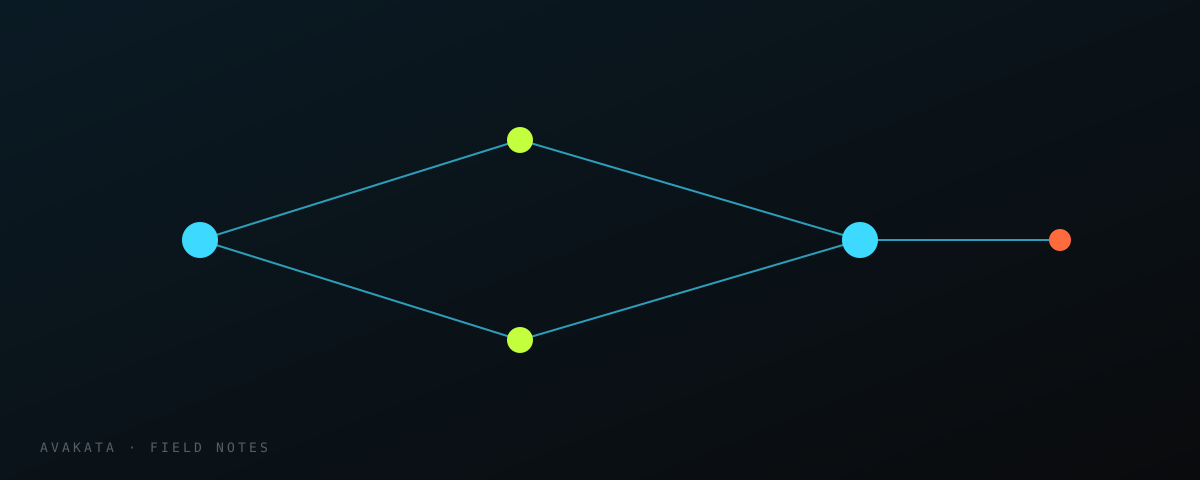
Every agent we run in production — writer, coder, analyst, outreach — ships its work through a gate it does not control: a separate critic model with a written rubric and the power to reject.
That one architectural rule has done more for output quality than any prompt improvement or model upgrade we have made this year. In June, critic gates rejected 19% of first drafts across our pipelines. Humans found defects in 0.4% of what got through. Before the gates existed, the human catch rate was 7%.
This is the case for giving every agent an editor, and the build notes for doing it.
Why an agent cannot edit its own work
Self-review fails for a structural reason: the model that produced an error produced it because, at generation time, the error looked right. Asking the same model, in the same context, whether it was right re-runs the same blind spot. Our tests made this concrete — self-critique caught 31% of planted defects, while a separate critic model working from a rubric caught 74% of the same set. The gap is not intelligence. It is vantage point.
Human writers already know this. Nobody proofreads their own draft well ten seconds after finishing it.
A fresh context window is the machine equivalent of a night's sleep.
The planted-defect test is worth running yourself: seed 50 outputs with known errors, ask the producer to self-check, then ask a separate critic. The two numbers will settle the architecture debate in an afternoon.
Fifty samples took us 90 minutes to build. The argument they ended had been running for a month.
What a critic gate actually is
A critic gate is a separate model call, with its own prompt and no memory of the generation, that receives the task brief and the draft, scores the draft against an explicit rubric, and returns one of three verdicts: pass, revise with notes, or reject and escalate. It sits between the producing agent and anything downstream — publishing, sending, committing. Nothing crosses without a verdict. The gate is code, not policy.
The three-verdict design matters. A binary pass-fail gate either nags or rubber-stamps.
Revise-with-notes is where most of the value lives: the producer gets specific, rubric-anchored feedback and one shot to fix it.
And separate means separate. Different prompt, different context, ideally a different model family, so the two share as few blind spots as possible.
Ours run 60 to 90 lines of prompt each — small enough to read in one sitting, stable enough that we version them like code.
Write the rubric before the prompt
The rubric is the real product of this work, and it should exist before the producing agent's prompt does. Ours run 8 to 14 checks per pipeline, split into hard fails — a factual claim without a source, a wrong client name, a banned phrase, a broken format — and scored dimensions like clarity, structure, and voice, each rated 1 to 5. Writing the rubric first forces you to define what good means in inspectable terms, which improves the producer's prompt for free.
If you cannot write the check, you do not yet know what you want. The rubric exposes that early, while it is still cheap.
Steal from your own history. Our best rubric lines came straight out of the rejection log we kept while reviewing agent drafts by hand.
Set the pass line where escalation is rare but real
Our gates pass a draft when it clears every hard fail and averages 4.0 or better across scored dimensions, with no single dimension below 3. Anything else gets one revision cycle with the critic's notes attached, and a second failure escalates to a human. Those thresholds put escalations at about 4% of tasks — frequent enough that the escalation path stays exercised, rare enough that the pipeline is genuinely autonomous. Tune the line to your stakes, but tune it in numbers.
One revision cycle, not three. Endless critic-producer loops burn tokens and converge slowly.
If a draft cannot pass in two attempts, the brief is usually the problem, and a human should see it anyway.
We also cap critic latency at 20 seconds. An editor that doubles pipeline time gets bypassed by impatient humans, and bypassed gates die quietly.
What the critics caught in June
The June ledger across four pipelines: 1,240 drafts, 236 rejections. The rejection causes break down cleanly — 38% unsupported claims or invented numbers, 24% voice and tone drift, 17% format violations, 12% instructions ignored somewhere in the brief, 9% everything else. The unsupported-claims share is the line that justifies the whole system. Those are exactly the errors that read fluently and embarrass you two weeks later.
Voice drift at 24% surprised us. It is the slowest defect for a tired human to spot and the fastest for a rubric to catch.
Format violations should be zero, you might think. The 17% says otherwise, and each one would have broken a downstream automation.
The catch mix also shifts by pipeline. The outreach critic catches mostly tone. The code critic catches mostly missing edge cases. Same architecture, different rubric.
Does a second model call pay for itself?
Yes, and it is not close. The critic adds 15-20% to token spend per deliverable — call it four cents on a typical post. One defect that reaches a client costs a rework cycle and an apology, which we cost at 45 minutes of human time, roughly $60 at our rates. At those prices the gate breaks even by preventing one miss per 1,500 deliverables. It prevents dozens. Run the arithmetic with your own numbers and the conclusion survives any reasonable inputs.
The critic also runs on a cheaper model than the producer in three of our four pipelines. Judging against a rubric is easier than writing.
The expensive editor is the one you do not have.
There is a growth dividend too. With the gate holding the floor, we doubled weekly output volume in April without adding a minute of review time. The gate is what makes scale safe, not just cheap.
When the critic is wrong
Critics fail in two directions. False passes show up in your human sample audits — ours run about 2% of passed drafts, which is why the sample never goes away entirely. False rejections show up as producers stuck in revision loops on work that was actually fine. We log every rejection reason and review the log weekly, and roughly one rubric check a month gets rewritten because it was rejecting good output. The gate gets edited too.
An unaudited critic drifts exactly like an unaudited writer.
Editor for the editor, sample for the sample. It is discipline all the way down.
Which is precisely why it works.