The client is a solo fractional CFO with 2,100 subscribers and, until March, a newsletter that went out whenever guilt won. Four issues in the previous six months. Every one took a full evening.
Since March 27 the newsletter has shipped every Friday at 10:06 a.m. — 14 straight issues at this writing — and the client's hands-on time is 25 minutes a week.
This is the anatomy of that pipeline, with the numbers, including the two near-misses.
Where things stood in March
The before picture: 2,100 subscribers, four issues in six months, a 31% average open rate, and zero attributable revenue. Each issue consumed three to four evening hours, which is exactly why issues did not happen. The list was warm — referrals and past contacts — but silence was letting it cool. The client's words: 'I know it works. I just never get to it.'
That sentence is the whole case. The bottleneck was not writing skill or material. It was a recurring block of hours that a solo operator's calendar refuses to yield.
Material was everywhere: client questions, quarter-end patterns, tax deadlines. Nobody was collecting it.
The list itself was an asset in hiding — 2,100 warm finance contacts going quiet at a rate you could feel in the pipeline.
What we built
The pipeline has four stages. All week, a collector agent files raw material — anonymized client questions, links the client saves, notes dictated after calls — into a single queue. Wednesday night, a drafting agent assembles the issue in the client's voice from a 900-word brand brief. Thursday morning, a critic agent checks claims, tone, and numbers against the brief and flags anything doubtful. Thursday at 4 p.m., the client reviews. Friday, the dispatcher sends.
The issue format is fixed: one 250-word lead insight, three short observations from the week, one number with a sentence of context, one reader question answered. Fixed formats are what make delegated writing reviewable.
Voice was trained from 30 of the client's own emails. The client writes dry and specific, and the first drafts did not. The brand brief now carries eleven banned phrases and four sentence-rhythm rules.
Nothing in the pipeline is exotic. A queue, two prompts with strong briefs, a checklist critic, and a scheduler. The design work was deciding where the human sits.
The collector is the piece most people skip and the piece that matters most. Fresh weekly material is the difference between a newsletter and content.
The Thursday gate: 25 minutes of human time
The client's entire weekly involvement is one 25-minute review at Thursday 4 p.m. The rules are explicit: read fully, edit anything, kill anything, and if the issue is not approved by Friday at 9 a.m., it does not send. The engine never publishes to 2,100 people on silence. Outcomes across 14 issues: nine sent as drafted, four lightly edited, one substantially rewritten.
No approval, no send. The rule sounds obvious and is the single most load-bearing decision in the design. It converts the engine from an autonomous publisher into a very fast staff writer.
Median edit: 40 words. The rewrite was issue five, the week of a market event, when the drafted take read as glib. Human judgment, correctly placed.
Twenty-five minutes is itself a designed number. Early versions asked for 45 and the review started slipping. A reliable small gate beats a skipped thorough one.
The numbers after 14 issues
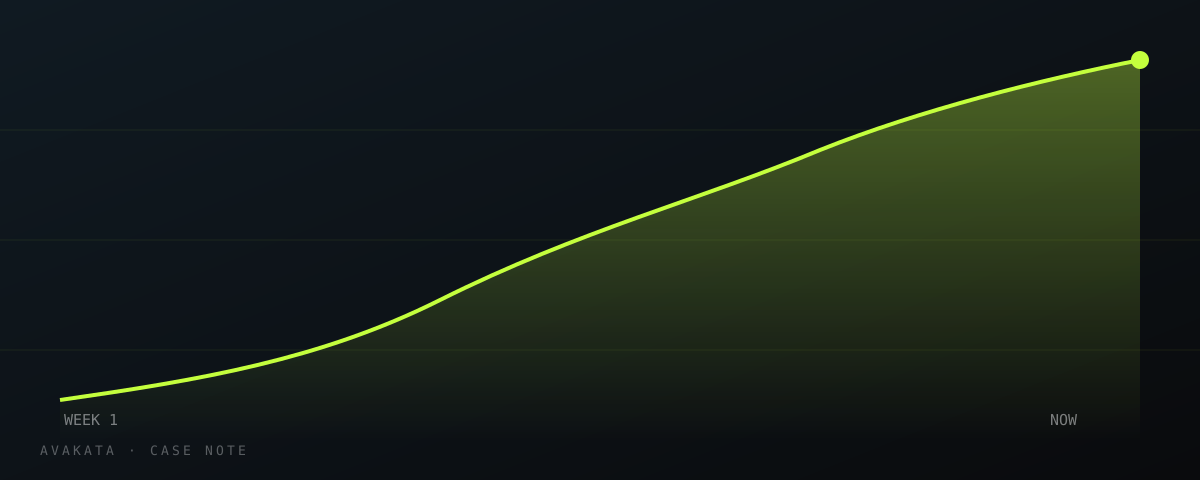
After 14 consecutive weekly issues: open rate up from 31% to 44%, click rate from 1.9% to 3.4%, and 118 net new subscribers with zero paid acquisition. Replies went from approximately never to six per issue on average. Three discovery calls and one signed engagement — worth roughly $21,000 a year — trace directly to newsletter replies. Unsubscribes: 41 total, front-loaded in the first month.
The open rate gain is mostly a consistency dividend. Show up every Friday and the audience builds the habit with you.
The early unsubscribes were the list shedding people who had forgotten subscribing. Traffic worth losing.
The number the client watches is replies. Six per issue from 2,100 finance decision-makers is a working pipeline, not a vanity stat.
For calibration: finance newsletters in this size band typically open between 35% and 42%. The client now sits above the band, having started below it.
What the engine learned issue over issue
The pipeline runs its own small experiments. Subject lines under 45 characters beat longer ones by 9% on opens across the first ten issues, so short became the default. Issues that led with a reader question outperformed issues that led with commentary on clicks, so the question moved to the top of the template. Send-time tests between 8:40 and 11:15 a.m. showed nothing. The 10:06 slot stays, out of superstition.
Each finding is small. Compounded over 14 issues, the newsletter the engine writes today is measurably different from the one it wrote in March, and nobody redesigned anything.
The client sees each result as one line in the Thursday note: what changed, what the data said. Ninety seconds of reading keeps the delegation informed.
Superstition is free when the data says the choice does not matter.
The two near-misses
Near-miss one: in week six the drafting agent cited a tax threshold that had changed in January. The critic caught the stale figure by checking it against a dated source list, and the fix took one line. Near-miss two: in week nine a dictated note contained a client company's name, and the collector's anonymization pass missed it. The Thursday gate caught that one. Both incidents produced new automated checks within a week.
This is the honest shape of production agent work. The system fails small, the gates catch it, and every catch becomes a permanent check. The failure list gets shorter and stranger over time.
The near-miss log is shared with the client quarterly. Trust in the system comes from seeing what it catches, not from being told it is safe.
Fourteen issues, two catches, zero incidents in front of subscribers.
What it costs and what it returns
Running cost is about $38 a month in model and infrastructure spend, plus the client's 25 weekly minutes — call it 1.7 hours a month of human time against the 14 to 16 hours the old process demanded, for four times the frequency and better quality control. Against one $21,000 engagement in the first quarter, the pipeline paid for its build inside nine weeks.
The build itself was 11 hours over two weeks, most of it voice training and anonymization rules rather than plumbing.
For a reader running the math at home: 1.7 hours a month of attention, $38 of spend, one warm channel compounding weekly. That trade is available to most solo practices.
The client still writes the newsletter, in every way that matters. The engine just makes Friday arrive on time.