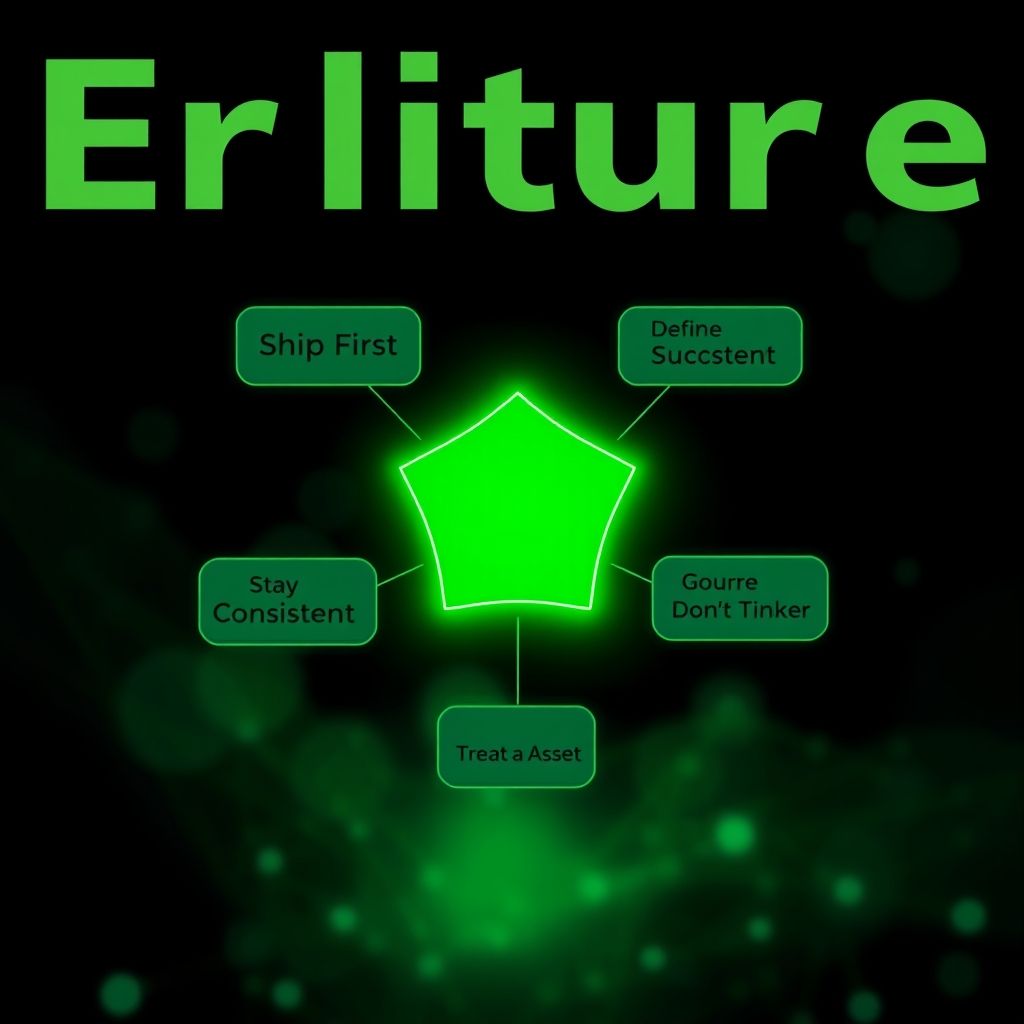
After 18 months of running an agentic one-person operation — and working closely with solopreneurs doing the same — a pattern is clear. The ones getting the best results share five traits. None of them are technical.
The differentiator is not which model they use, how many tools they have, or how deep their prompt engineering goes. It is how they operate. Here are the five traits, in order of how often I see them missing.
Trait 1: they ship before they optimize
The best AI solopreneurs ship imperfect workflows and refine from real data. They run a workflow on ten real tasks, see where it breaks, and fix those specific breaks.
The worst ones spend weeks optimizing a prompt they have never run on real work. They tune for hypothetical failure modes that may not exist, while missing the actual ones that do.
Real data beats theoretical optimization every time. A workflow that has processed 50 real tasks and been patched twice is more reliable than one that has been perfected in isolation and never shipped.
The rule they follow: ship when it works 60% of the time. Optimize to 80% from real failures.
Trait 2: they define success before they build
Every workflow has a success metric written before the first prompt is run.
Not a vague goal. A specific, measurable definition: "This workflow succeeds if it produces a usable draft in under 10 minutes, 80% of the time." That definition is written down before anything is built.
Without that definition, there is no feedback loop. You cannot tell if the workflow is improving, degrading, or just different. You end up optimizing by feel, which is not optimization — it is drift.
The metric does not have to be sophisticated. It has to exist.
Trait 3: they are consistent, not prolific
One AI workflow used daily beats ten workflows used occasionally. The compounding happens through repetition, not variety.
The best AI solopreneurs have a small, stable stack — typically three to five core workflows — that they use every day. They know exactly what each one produces, where it fails, and how to interpret its output.
The worst have a large, rotating stack. They adopt every new tool, run each one a handful of times, and never build enough repetitions to understand what they actually have. The stack stays shallow.
Consistency is what produces compounding. Each run of a familiar workflow generates a data point. Enough data points and you can see the pattern. You cannot see the pattern in a workflow you have run four times.
Trait 4: they govern, not tinker
The best AI solopreneurs set standards and review outputs against those standards. They do not spend time inside the model — adjusting parameters, chasing the latest release, or experimenting with system prompts for their own sake.
They treat the model as a black box that produces output against their standard. Their job is to evaluate the output, not to understand the model. When the output meets the standard, they ship it. When it does not, they log the failure and decide whether to fix the workflow or accept the miss.
This is a governance posture, not a technical one. It requires discipline to stay out of the model and stay focused on the output. Most people cannot do it. They get pulled into the model because the model is interesting. The output is what matters.
Trait 5: they treat the stack as a business asset
They document their prompts. They version their workflows. They protect their evaluation criteria the way a business protects its processes.
They know that the stack is the asset, not the model. The model is a commodity that will be replaced. The prompts, the workflows, the evaluation rubrics, the failure logs — those are proprietary. Those took time to build and cannot be replicated by copying a model name.
When a new model releases, they migrate the asset. They run their existing workflows against the new model, measure against their existing success criteria, and decide whether to switch. They do not start over. They do not rebuild from scratch because the interface changed.
The stack is the moat. They treat it accordingly.
The common thread
All five traits are governance traits, not technical traits.
Shipping before optimizing is a discipline. Defining success before building is a discipline. Staying consistent is a discipline. Governing instead of tinkering is a discipline. Treating the stack as an asset is a discipline.
The best AI solopreneurs are good operators. They set standards, ship consistently, measure outcomes, and refine systematically. The technology is secondary to the operating discipline. A mediocre model run by a good operator outperforms a frontier model run by someone who has not thought about what success looks like.
This is not a new insight. It is the same thing that separates good businesses from bad ones. AI just makes the gap visible faster.
What to do with this
Audit yourself against the five traits. Be honest.
Which ones do you have? Which ones are missing? The missing ones are your highest-leverage improvement areas — not because they are the hardest, but because they are the ones creating the most drag on everything else you are doing.
Start with the one that is furthest from your current practice. Not the easiest one. The furthest one. That is where the compounding is being lost.
If you are not sure which one that is, the answer is almost always Trait 2. Most people have never written a success metric for a workflow they use every day.
We send a monthly self-audit template — the five traits, scored and with improvement actions — to Field Notes subscribers. Get it at avakata.agency/contact.html.
If you want to work through the audit with someone who has seen it across a range of one-person operations, book a discovery call. No pitch. We look at your stack, score it against the five traits, and tell you where the leverage is.