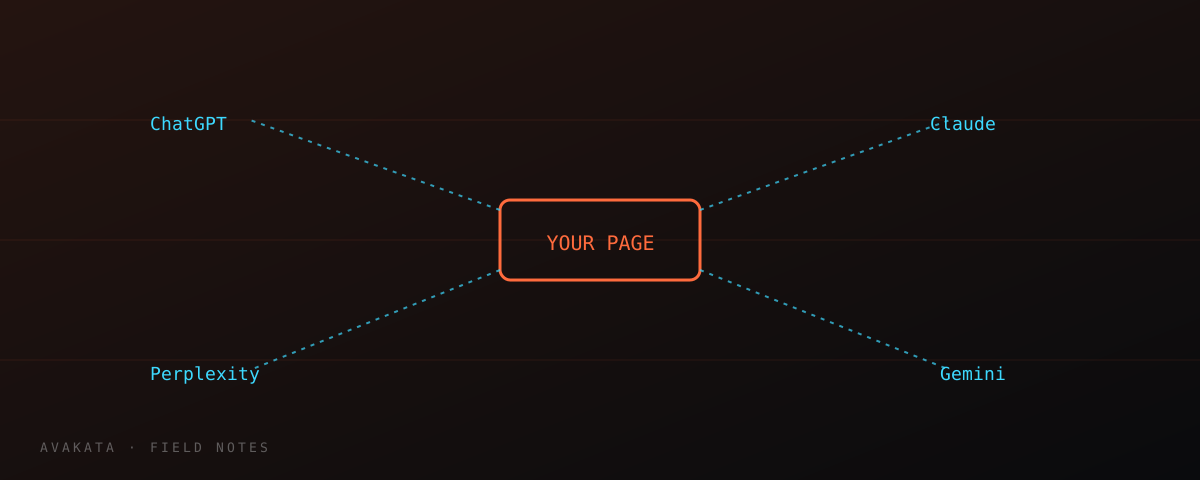
For thirty years, search engine optimization optimized for one thing: a position on a ranked list. You wanted to be result number one, or at worst number three, on a page of ten blue links. Everything — keywords, backlinks, page speed — laddered up to that single goal.
That game is quietly ending. ChatGPT, Perplexity, Google's AI Overviews, and Claude do not return a ranked list. They return one synthesized answer, assembled from multiple sources, with citations embedded at varying positions and varying levels of influence. The user often never sees a list at all. They see a paragraph — and a few small superscript links deciding which brands get credit.
This is the shift behind generative engine optimization (GEO): the discipline of getting your content selected, trusted, and cited by a generative model, whether or not anyone clicks through. Below is what GEO actually is, what we have measured across six months of client audits, and a concrete playbook you can run this week.
What is generative engine optimization (GEO)?
Generative engine optimization is the practice of structuring and writing content so that AI answer engines can confidently extract, attribute, and cite it when generating a response. Where classic SEO competes for a rank, GEO competes for a citation inside someone else's synthesized answer.
The mechanics are different enough that old instincts mislead. A generative engine reads a query, retrieves a set of candidate passages, and composes an answer by lifting and paraphrasing the passages it trusts most. Your page is no longer a destination competing for a click — it is a source competing to be the sentence the model quotes. That reframes almost every on-page decision.
Ranking asks: where does my page sit on the results page? Citation asks: when the model writes the answer, whose words does it use? Those are not the same question, and they do not have the same answers.
How is GEO different from traditional SEO?
GEO and SEO overlap — both reward genuine authority and clean technical foundations — but they diverge on what winning looks like. Three differences matter most in practice.
Visibility no longer depends on a click
In classic SEO, an impression with no click is a near-total loss. In GEO, a model can cite your brand as the trusted source of a claim and the user may act on it — form an opinion, shortlist you, repeat your framing — without ever visiting. The unit of value moves from session to mention.
The winner is a passage, not a page
Google ranks pages. Generative engines lift passages. A 3,000-word page can rank well yet never get cited because no single paragraph is cleanly extractable. Conversely, one tightly written 60-word answer in the middle of an average page can become the snippet three different engines quote. GEO optimizes the passage.
Structure is a ranking signal in itself
Models reward content they can parse without ambiguity: question-shaped headings, direct-answer lead-ins, definition sentences, lists, and tables. The Princeton GEO research that named the field found that adding citations, quotations, and statistics to a passage raised its visibility in generative answers by up to 40%. Format is not cosmetic here; it is the optimization.
Which on-page signals actually raise AI citation rate?
This is where opinions are cheap and data is expensive. Across six months of LLM audits on client sites — tracking which pages got cited by Perplexity and AI Overviews, and what changed when a page started or stopped being cited — four signals separated from the noise.
1. An extractable lead-in answer (highest leverage)
The single biggest lever is a self-contained answer of roughly 40–90 words placed immediately under a clear, question-shaped heading. Engines are excellent at lifting clean opening passages and poor at synthesizing scattered prose. If the first sentences under a heading fully answer the heading — no setup, no "as we discussed above" — your odds of being the cited source rise sharply. Lead with the answer, then expand.
2. A visible freshness stamp
Pages with a visible "last updated" date get cited noticeably more often than pages without one — in our audit set, on the order of 2x for the same content. Models treat visible recency as a trust signal because users do. The fix is nearly free: surface an honest updated date on every important page and keep it honest.
3. A named author with a credential
A byline that names a real person and gives a one-line credential ("co-founder of what became Google Analytics") raises citation for the same reason peer review does: attributable expertise is more trustworthy than anonymous text. Author schema helps, but the visible, human byline is what moves the number.
4. Structured evidence — statistics, quotes, citations
Passages that state a specific number, attribute a quote, or cite a source get lifted more than passages of confident-but-vague prose. "Citation rate roughly doubled" beats "citation improved a lot." Give the model concrete, attributable facts and it will reuse them — with your name attached.
What does NOT move citation as much as people think
Two things the LLM-era SEO industry oversells, against our data.
- Raw word count. Above ~1,200 words, citation rate shows steep diminishing returns. A 2,400-word piece is not twice as citable as a tight 1,200-word one. Structure and extractability beat length almost every time.
- Exotic schema. Article, Author, and FAQPage schema all earn their keep. The long tail of rarely-used schema types makes essentially no measurable difference to citation. Do the basics well; skip the cargo cult.
A GEO playbook you can run this week
If you are doing this by hand, here is the order of operations that returns the most citation per hour of effort. None of it is glamorous; all of it works.
- Add a visible "last updated" stamp to your top 20 pages — today.
- Put a named author byline with a one-line credential on each of those pages.
- Rewrite the first 40–90 words under each major heading so the passage stands alone as a complete answer to that heading.
- Turn your most common support and sales questions into an FAQ block, wrapped in FAQPage schema.
- Run an LLM audit once a month — ask the engines real buyer questions and record who they cite. You cannot optimize what you do not measure.
If you would rather have that audit run continuously — with an engine that takes the diff and ships the change the moment a page that should be cited stops being cited — that is precisely what Avakata does. Book a 30-minute discovery and we will run your first citation audit live on the call.