The most valuable AI agents we run are deeply, intentionally boring. They do one narrow thing, they do it the same way every time, they write down what they did, and they can be undone in one step. None of them would make a good demo. All of them ship value every single day.
This runs against the cultural current, which prizes the general-purpose agent that can browse, reason, code, and improvise its way through any task. Those demos are thrilling. They are also, in our experience, the agents least likely to survive contact with a real production system. This piece argues for boredom as a design principle — and shows what a boring agent actually looks like.
What makes an AI agent "boring"?
A boring agent is narrow, predictable, observable, and reversible. It has a small, fixed toolset; a tightly scoped job; a complete log of everything it touches; and a one-step rollback. You can predict what it will do before it runs, and you can prove what it did afterward. That is the entire spec, and it is harder to hit than it sounds.
Contrast that with the exciting version: an open-ended planner with broad tool access that decides at runtime how to accomplish a fuzzy goal. The exciting agent is impressive precisely because you cannot predict it — which is also exactly why you cannot trust it with anything that matters. Surprise is fun in a demo and a liability in production.
An agent you cannot predict is an agent you cannot trust. An agent you cannot roll back is one you should not deploy.
Why do narrow agents outperform general ones in production?
Narrow agents outperform because reliability is a product of constraint, and production rewards reliability over capability. A single-purpose agent has a small failure surface, a tractable test suite, and behavior you can actually reason about. When it breaks, you know where to look. When it succeeds, you know why.
Small toolsets fail in small ways
Every tool you grant an agent multiplies the space of things it can do — including the wrong things. An agent with three tools has a failure space you can enumerate; an agent with thirty has one you can only hope to monitor. We grant the minimum and add tools only when a real task demands them.
Tight scope makes evaluation possible
You can write a meaningful test for "rewrite this product description to match brand voice." You cannot write a meaningful test for "improve the website." Narrow scope is what makes an agent evaluable, and an agent you cannot evaluate is an agent you cannot improve.
How do you make an agent observable and reversible?
Observability and reversibility are not features you add later; they are constraints you design around from the first line. Concretely, that means three rules we apply to every agent in the fleet.
- Every action is logged with enough context to answer "what did this do, and why" months later.
- Every change is attributable to a specific agent, a specific input, and a specific decision.
- Every change is reversible in one step — if you cannot cleanly undo it, the agent does not get to do it autonomously.
This is why "boring" and "auditable" turn out to be the same property viewed from two angles. The agent that logs everything and can always be rolled back is, by construction, an agent that never does anything dramatic. That is the point.
How do you measure a boring agent?
Measure agents on shipped, accepted changes — not on autonomy, not on apparent intelligence, not on how little human input they needed. The only number that matters is how much real, kept improvement they produced. An agent that proposes ten changes and gets one accepted is worse than one that proposes two and gets both kept.
This metric quietly kills a lot of impressive-looking work. An agent that confidently rewrites half your site but whose changes get reverted has negative value — it cost review time and shipped nothing. Boredom optimizes for the opposite: a steady stream of small, correct, kept changes.
Boredom scales: the fleet beats the genius
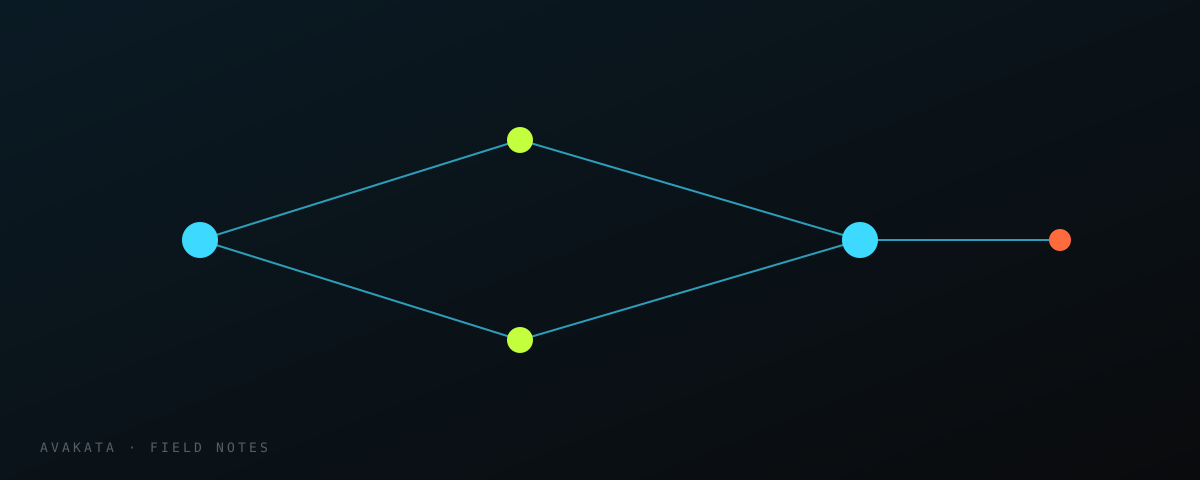
The strongest argument for boring agents is architectural. A fleet of narrow, single-purpose agents coordinated by an orchestrator outperforms one ambitious generalist, for the same reason a well-run team beats a lone hero: specialization, parallelism, and contained failure. When one boring agent breaks, the other 159 keep working.
That is how the Avakata engine is built — over 160 narrow specialists across engineering, design, data, marketing, and support, each boring on its own, coordinated into something that looks, from the outside, like one tireless operator. The capability is emergent; the components are dull by design. We wrote about why we keep that orchestration layer opaque in Why the orchestration graph stays a black box. If you want to see the fleet run on your site, book a discovery.