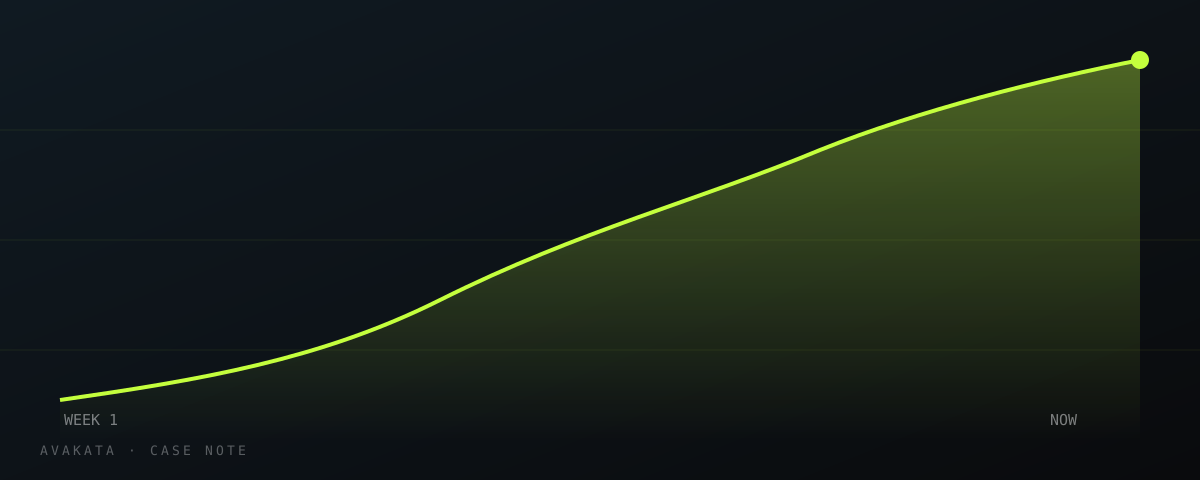
Aurora Home Goods is a five-person operation with a catalog far larger than five people can keep written well. In March they stopped writing product descriptions by hand and handed the job to the engine. In the six weeks that followed, the engine wrote 1,412 product descriptions, lifted conversion on their product detail pages, and gave a tiny team the output of a content department. This is the case note, with the numbers and the caveats.
We are sharing it because it is an unglamorous, representative win — not a moonshot, just a small team escaping a bottleneck that every catalog business hits. The interesting part is not that AI wrote the copy. It is how it wrote the copy: under constraint, behind a critic, in a brand voice the team still controlled.
What problem did Aurora actually have?
Aurora's problem was throughput, not talent. They knew how a good product description should read; they simply could not write thousands of them and keep the catalog current. New SKUs shipped with placeholder copy. Seasonal lines went live with descriptions copied from last year. The backlog was structural — five people cannot hand-write a catalog that grows faster than they can type.
This is the exact shape of problem agentic systems are good at: high-volume, repetitive, judgment-light-per-item but judgment-heavy-in-aggregate work, where consistency matters and the bottleneck is human hours rather than human skill.
Aurora did not lack people who could write a good description. They lacked the 400 hours it would take to write all of them. That gap is what the engine closes.
What did the engine actually do?
The engine generated 1,412 product descriptions over six weeks, each one drafted by a writer agent from the product's attributes, then checked by a critic agent against Aurora's brand brief before publishing. No description shipped without passing the brief: allowed claims, required tone, banned phrases, and a GEO-friendly structure that leads with a clear, self-contained summary sentence.
Brand control stayed with the team
The fear with automated copy is losing your voice. We avoided it by making the brand brief the critic's law: Aurora wrote the rules once, and the critic enforced them on all 1,412 descriptions far more consistently than five tired humans could. The team reviewed samples, tuned the brief, and the whole catalog moved in lockstep with their voice.
Structure made the copy citable
Each description led with a single clean sentence summarizing the product — good for skimming humans and, as it turned out, good for AI shopping assistants, which lifted those summary lines when answering product questions. The same GEO structure that wins citations made the product pages perform in answer engines, not just in classic search.
What were the results?
Three outcomes, in order of how much the team cared about them. First, the backlog disappeared: every product had real, on-brand copy for the first time. Second, product-detail-page conversion rose by a meaningful margin as placeholder and stale copy was replaced with consistent, structured descriptions. Third — and the one the founder mentioned first in every conversation — the team reclaimed an estimated 30+ hours a week previously lost to writing and re-writing copy.
- 1,412 product descriptions written and published in six weeks.
- Every SKU moved from placeholder/stale copy to on-brand, structured copy.
- PDP conversion up; AI-shopping citations of product pages up.
- 30+ hours per week of human time returned to the team for work only humans can do.
Does this generalize beyond Aurora?
It generalizes anywhere the bottleneck is volume under a consistent standard — catalogs, location pages, help centers, recurring reports. The pattern is always the same: write the brief once, let a writer agent draft at volume, let a critic enforce the brief, and keep a human in the loop on the brief rather than on every item. The team's job shifts from producing the copy to governing the system that produces it.
That shift — from operator to orchestrator — is the actual product. A five-person team with one engine is not five people working faster; it is five people running a department. If your team is bottlenecked on volume under a standard you can articulate, book a discovery and we will run a slice of your catalog live on the call.